Home / Buyer's guides / Why cabinet edges peel: hand-pasted vs machine PUR sealing
Buyer's guide, 2026-11-28
Why cabinet edges peel: hand-pasted vs machine PUR sealing
Why do cabinet edges peel?
The edge is where water gets in. Edges are often pasted by hand with glue and depend on one person's skill, and over the years the joint line can show or the glue can weaken. Machine-applied PUR edging seals the same way every time.
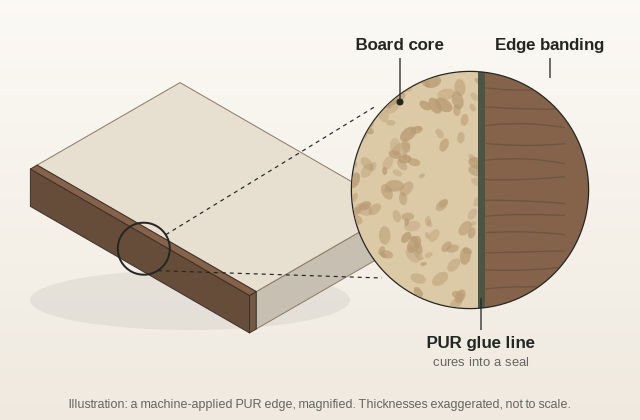
What happens at the edge?
The strip of banding covers the cut edge of the board. If the seal is weak, moisture reaches the core and the board can swell. In a Singapore flat that is most often near a kitchen sink, in a bathroom, or anywhere the air stays humid.
Why PUR, applied by machine?
PUR glue cures into a seal that handles moisture and heat better than EVA. A machine controls the glue, the pressure and the speed, so the result does not depend on one person's hand. Apex edges are machine-applied PUR. We do not use ABS edging as standard, but we can supply it if you ask.
What can you check?
Look at a cut-edge sample and run a fingernail along the joint line. Ask how the edge is applied and which glue is used.
What you can verify
- Machine or hand: ask how the edge is applied
- Which glue: PUR or something else
- Joint line: look at a sample, close up
- Edges near the sink and in the bathroom, where moisture shows first

This guide describes how Apex builds. It makes no claim about any other company's work. Check what matters to you in writing, whoever you choose.